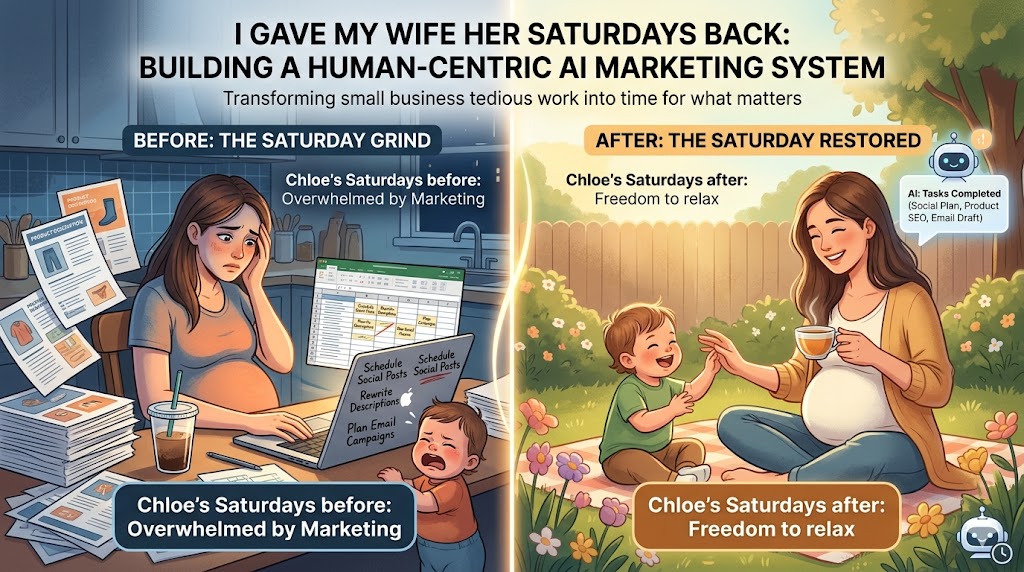
Last weekend I gave my wife her Saturdays back.
She runs a small eCommerce business. She is also pregnant and already chasing a toddler. The last thing she needed was another hour spent writing product descriptions, planning social media content, or scheduling email campaigns.
So I spent a weekend building her an AI marketing system. Here is exactly what I built, how it works, and what I learned.
What the system does
The system now handles four things automatically, without Chloe touching it:
- Social media content strategy — generates a weekly content plan across platforms, scheduled and ready to publish.
- Product description rewrites — takes existing product listings and rewrites them for SEO, automatically improving discoverability without manual effort.
- Email campaign drafts — generates campaign copy based on the products and promotions she wants to run.
Everything a part-time marketing intern would do — for the cost of API calls.
The technical architecture
I used Claude Code alongside custom Python scripts I had already developed for other projects. The interface layer is OpenClaw, which lets Chloe interact with the whole system via a Telegram bot — she sends a message, the agent does the work.
The key architectural decision: I built it model-agnostic from the start. The interface and the model are completely decoupled. For repetitive high-volume tasks — product description rewrites, content scheduling — I swapped the underlying model to Qwen. Same outputs, significantly lower cost. The Telegram bot has no idea which model is running.
For tasks requiring more nuance — strategic content planning, campaign copy that needs to match brand voice — stronger models handle those requests.
The whole build took one weekend. She has not had to think about content planning since.
What this revealed about the AI gap
Here is what struck me building this: the gap between a technical person who understands LLMs and a non-technical person who could benefit from them is enormous.
My wife is smart and capable. She runs a real business with real customers. But without someone to bridge that gap for her, this system simply would not exist. She would still be spending her limited free time on tasks that a well-configured AI agent can handle in seconds.
That gap is where most small business owners are sitting right now. They know AI should be helping them. They see the headlines. They just have no idea where to start — and the tools that exist require technical knowledge to configure properly.
The broader lesson
I have spent my career building AI systems at enterprise scale — AWS, WooliesX, Linkby. Petabytes of data, teams of 20, complex MLOps pipelines. That work is genuinely hard and genuinely valuable.
But this weekend project reminded me that some of the highest-impact AI work is not the most technically sophisticated. It is finding the person who is spending three hours a week on something that should take ten minutes — and building the bridge.
If you run a small business and you are spending time on repetitive marketing tasks, this problem is solved. The tools exist. You just need someone to wire them together properly.
What repetitive task in your business would you automate first if you could? I am genuinely curious — and I might just build it. Drop a comment on LinkedIn.